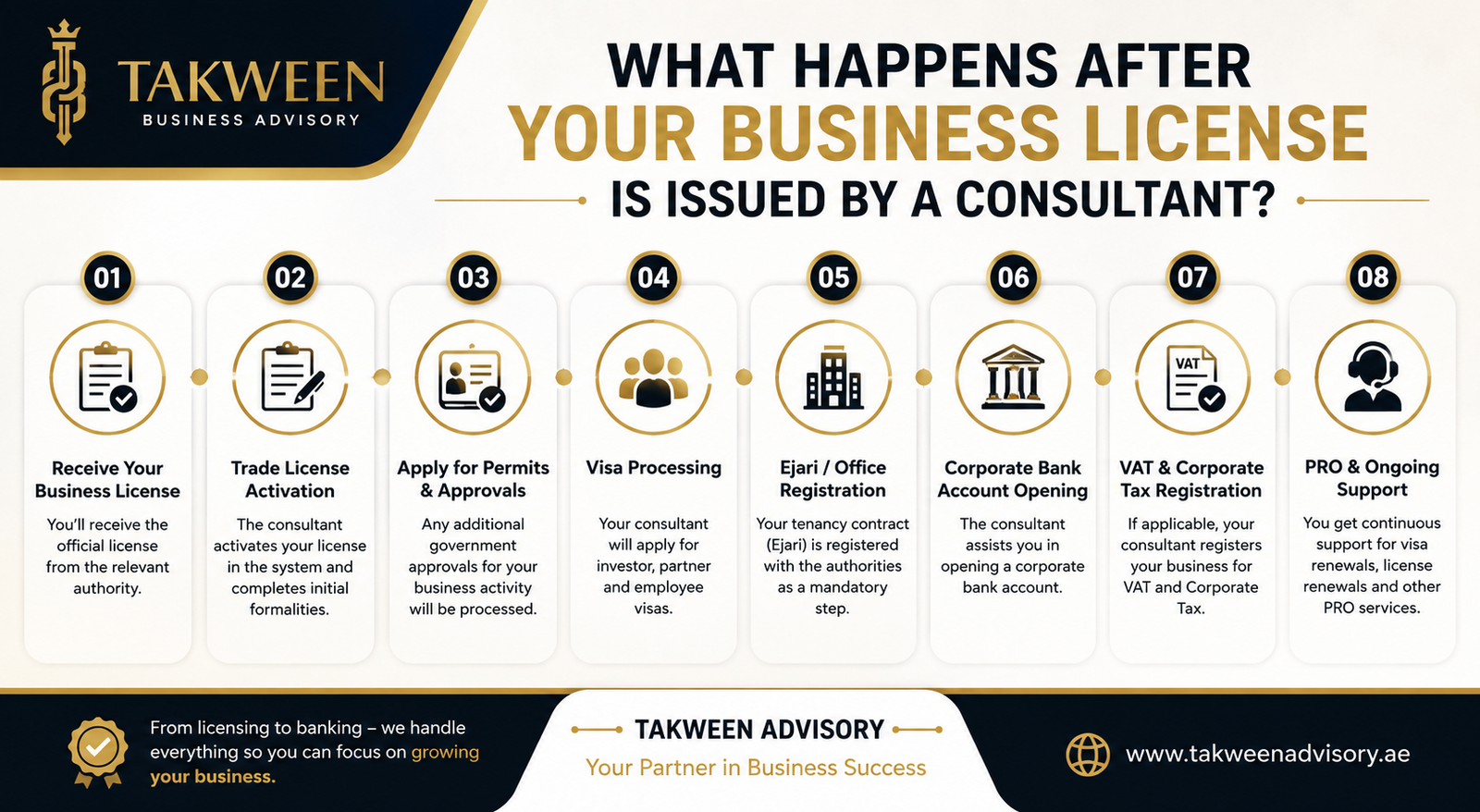
Getting your trade license issued in Dubai feels like the finish line - and understandably so, after weeks of paperwork, approvals, and back-and-forth with government authorities. But here's what many first-time entrepreneurs don't realize: the license is actually the starting point, not the destination. It's your legal permission to operate, but there's a distinct sequence of steps that still needs to happen before you can genuinely open your doors, sign contracts, hire staff, or pay yourself.
If you've recently worked with new business setup consultants in dubai to get your license issued, this guide walks you through exactly what comes next - so you know what to expect, in what order, and why each step matters.
Your License Is the Foundation, Not the Finish Line
Think of your trade license as the legal identity of your company. It confirms that a government authority - whether the Department of Economy and Tourism (DET) for mainland companies or a free zone authority - has approved your business activity and recognizes your company as a legal entity. Alongside the license itself, you'll typically receive your Memorandum of Association (MOA), your certificate of incorporation, and your registration certificate.
What it does not do is automatically give you a functioning business. You still can't open a corporate bank account, sponsor visas, hire employees, or legally invoice clients until several more steps are completed. Understanding this sequence is what separates a smooth post-licensing transition from months of unnecessary delay.
Step 1: Apply for Your Establishment Card (Immigration File)
The very first thing that happens after your license is issued is the application for an Establishment Card, sometimes referred to as your company's Immigration File. This document registers your company with the Federal Authority for Identity and Citizenship, and it's what allows you to apply for entry permits, residence visas, and labor cards for yourself and any future employees.
This step is non-negotiable - your Establishment Card must be active before any visa processing can begin, for you or anyone else associated with the company. If you're already in the UAE on a tourist visa or a previous employment visa, this is also the stage where a "change of status" typically happens, transitioning your immigration status onto your new company's sponsorship.
Step 2: Sort Out Your Office Space and Ejari (If Not Already Done)
If you haven't already finalized your office arrangement - whether a physical office, a flexi-desk, or a virtual office - this needs to be locked in early, because it directly affects how many visas your company can sponsor. As a general guide, a flexi-desk arrangement typically allows for a smaller visa quota, while a full physical office generally supports a larger one. For mainland companies, this lease needs to be registered through Ejari before it can support your Establishment Card and visa applications.
Step 3: Apply for Your Own Investor or Partner Visa
With your Establishment Card active, you can now begin your own residency visa process. This typically involves an entry permit, a status change or medical fitness test, Emirates ID registration, and visa stamping. Once your own visa is issued, you become eligible to sponsor visas for your family members, business partners, and eventually your employees.
It's worth noting that visa renewal requirements have become more detailed in recent years, often requiring proof of an active company lease and evidence of maintained business activity - so keeping your documentation current from day one matters more than it used to.
Step 4: Open Your Corporate Bank Account
This is frequently the step that catches new business owners off guard - a trade license is a legal formality, but a bank account is what makes your business operational in reality. You cannot legally receive payments, pay invoices, or run payroll without one.
Banks in the UAE have tightened their compliance and Know Your Customer (KYC) requirements considerably, so this stage often requires a well-prepared documentation package: your trade license, MOA, Establishment Card, proof of your residence visa, and a clear explanation of your business activity and expected transaction volume. Many entrepreneurs find this the most time-consuming part of the post-licensing journey, which is exactly why working with a consultant who prepares banking documentation properly from the outset can save significant back-and-forth.
Step 5: Register for Corporate Tax (and VAT, If Applicable)
This is one of the most commonly overlooked steps - and one of the costliest to ignore. Every business in the UAE, whether mainland or free zone, is required to register for Corporate Tax with the Federal Tax Authority (FTA), regardless of whether the business currently owes any tax. Even sole establishments and small consultancies are considered "taxable persons" under the law.
Missing the registration window carries a real penalty - businesses that fail to register within the required timeframe after license issuance can face a fine as high as AED 10,000. On top of Corporate Tax, if your annual turnover exceeds AED 375,000, VAT registration becomes mandatory as well, with voluntary registration available at a lower turnover threshold for businesses that want to register early.
Standard Corporate Tax in the UAE is 9% on taxable profits above AED 375,000, though Small Business Relief is available for businesses with revenue under AED 3 million, and qualifying free zone entities may benefit from a 0% rate on qualifying income under specific conditions.
Step 6: Handle Sector-Specific Approvals (If Applicable)
If your business operates in a regulated field - such as healthcare, education, legal services, or engineering - you may need additional approvals from bodies like the Dubai Health Authority, the Knowledge and Human Development Authority (KHDA), or relevant municipal departments. These external approvals can add meaningful time to your post-licensing timeline, so it's worth confirming early whether your activity falls into one of these categories.
Step 7: Set Up Ongoing Compliance Systems
Once the core setup is complete, the focus shifts to keeping everything in good standing. This includes:
-
Annual license renewal, since most trade licenses and office leases are valid for one year and need renewal before expiry.
-
Ejari renewal, typically required at least 30 days before your existing tenancy registration expires.
-
Establishment Card and labor file maintenance, since these are directly tied to your ability to issue and renew employee visas.
-
Ongoing tax filing obligations, including Corporate Tax returns and VAT filings if applicable.
Missing any of these renewals can create serious downstream problems - an expired Ejari or Establishment Card can freeze your ability to process visas, and in some cases, even affect your corporate bank account status.
Why the Right Consultant Matters Beyond Just Licensing
A lot of entrepreneurs assume the job of a business setup consultant ends the moment the trade license lands in their inbox. In reality, the value of working with experienced new business setup consultants in dubai often shows up most clearly in this post-licensing phase - helping you sequence the Establishment Card, visa processing, bank account opening, and tax registration correctly, so nothing stalls and nothing gets missed.
Founders who try to navigate this stage alone often lose weeks to avoidable delays: banking documentation that's incomplete, a visa application submitted before the Establishment Card was active, or a tax registration deadline that quietly passed unnoticed. A good consultant doesn't just get your license issued - they map out the full sequence in advance and manage it end to end, so you can focus on actually running your business.
Frequently Asked Questions
Q1: Can I start doing business as soon as my trade license is issued?
Not fully. While your license gives you legal permission to operate, you'll still need an active corporate bank account, and in most cases, a residence visa, before you can genuinely start signing contracts and receiving payments.
Q2: What is an Establishment Card, and why do I need one?
An Establishment Card, or Immigration File, registers your company with UAE immigration authorities. It's required before you can apply for any residence visa - for yourself, your partners, or your employees.
Q3: How soon after getting my license do I need to register for Corporate Tax?
Registration is required within a set window after your license is issued, and missing it can result in a penalty as high as AED 10,000, regardless of whether your business currently owes any tax.
Q4: Why is opening a corporate bank account often the hardest part?
UAE banks apply strict KYC and compliance checks, and incomplete documentation is the most common reason for delays. A well-prepared documentation package - including your license, MOA, Establishment Card, and visa - makes the process significantly smoother.
Q5: Do I need a physical office to sponsor employee visas?
It depends on your visa quota needs. A flexi-desk arrangement typically supports a smaller number of visas, while a full physical office generally allows for a larger quota - so it's worth planning your office setup around your hiring goals.
Q6: What happens if I miss my Ejari or license renewal deadline?
Renewals are generally required annually, and missing them can affect your Establishment Card status, freeze visa processing, and in some cases impact your corporate bank account - so staying ahead of these dates is essential.
Let Us Handle What Comes Next
Getting your license issued is a major milestone, but it's only the beginning of building an operational, compliant business in Dubai. At Takween Advisory, we don't just get your license issued - we guide you through every step that follows, from your Establishment Card and visa processing to bank account setup and tax registration, so nothing falls through the cracks. Get in touch with our team today to make sure your post-licensing journey is smooth from day one.