Businesses today are managing more information, customer interactions, documents, and operational tasks than ever before. Traditional processes that depend heavily on manual work can make it difficult for teams to respond quickly and maintain consistent productivity. Artificial intelligence is changing this environment by connecting people, systems, data, and automated processes through intelligent digital solutions.
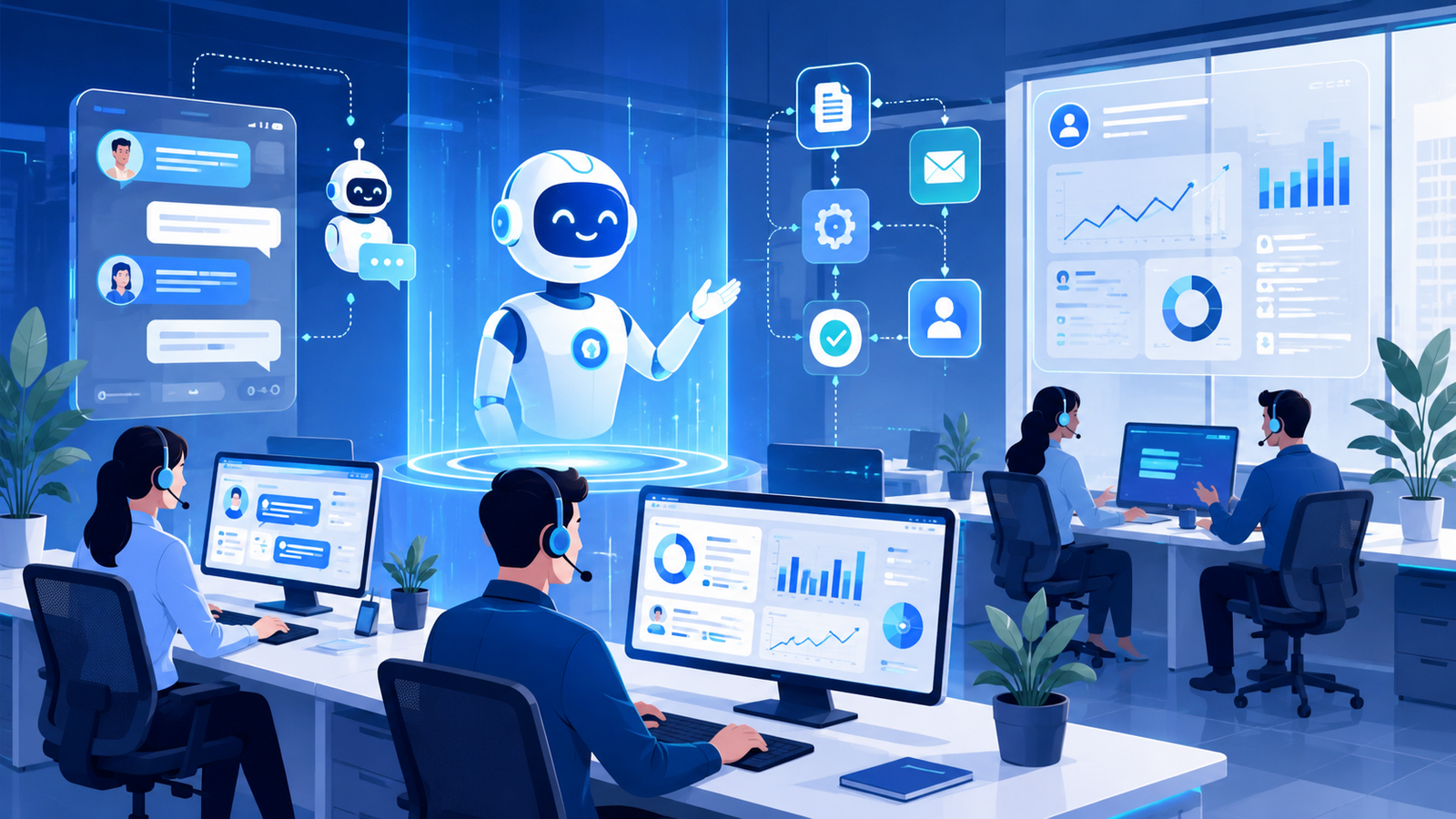
The image of a modern AI-powered workplace represents this transformation. AI assistants work alongside employees, business information moves between connected systems, and dashboards provide real-time visibility into operations. Instead of treating every task separately, organizations can create connected workflows where technology supports employees throughout the entire business process.
The Shift Toward Intelligent Business Operations
Modern organizations need more than basic automation. They need systems that can understand information, identify patterns, assist employees, and take action based on predefined business requirements.
This is where Generative AI solutions for business can create significant value. These solutions can support activities such as content generation, information analysis, customer communication, knowledge management, reporting, and decision support.
For example, an AI-powered customer support environment can help agents understand customer queries, retrieve relevant information, summarize previous conversations, and recommend appropriate responses. Employees can then focus on complex customer requirements instead of spending time searching through multiple systems.
Connecting Business Data and Enterprise Systems
One of the biggest challenges organizations face is fragmented information. Customer details may exist in a CRM, financial information may be stored in another application, while documents and internal communications may be spread across different platforms.
AI can help bring these information sources together and make them easier to access. Connected systems allow employees to work with more complete information while reducing the need to manually transfer data between applications.
A modern AI environment can connect documents, customer records, workflows, emails, approvals, and analytics dashboards. This creates a more coordinated digital workplace where information can move efficiently between different teams.
Smarter Document Processing
Documents remain an important part of business operations. Organizations handle invoices, contracts, purchase orders, applications, forms, reports, and customer documents every day.
Traditional document handling often requires employees to manually read files, identify relevant information, enter data into business systems, and verify the results. This process can be time-consuming and may increase the possibility of human error.
AI document processing software can help automate these activities. Intelligent systems can identify document types, extract relevant information, classify files, and make structured data available to other business applications.
For example, an invoice can be automatically analyzed to identify the supplier name, invoice number, date, tax information, and total amount. The extracted information can then move into an approval or accounting workflow without requiring employees to manually enter every field.
AI-Powered Customer Support
The customer support environment shown in the image represents another important area where AI can improve productivity. Support teams often handle large numbers of customer questions simultaneously. Searching for information and maintaining consistent responses can become difficult as the volume of interactions increases.
AI assistants can help support teams by analyzing incoming queries, retrieving relevant information, summarizing customer history, and suggesting responses. They can also assist with routing requests to the appropriate department.
This does not necessarily mean replacing human support teams. Instead, AI can act as an intelligent assistant that helps employees work faster and access relevant information when they need it.
Automating Repetitive Workflows
Many business processes involve repetitive steps such as data entry, approvals, notifications, task assignments, and status updates. Automating these activities can allow employees to spend more time on higher-value responsibilities.
Organizations looking for workflow automation AI in India are increasingly exploring intelligent systems that can connect multiple business applications and automate processes across departments.
For instance, when a new customer submits an application, an automated workflow can collect the required documents, extract information, validate the data, route the request for approval, and update the relevant business system. Each stage can trigger the next action automatically.
This approach improves process visibility while reducing unnecessary delays and manual coordination.
Real-Time Analytics for Better Decisions
The dashboards represented in the image also highlight the importance of real-time business intelligence. Managers need visibility into performance, customer activity, workflow status, and operational trends to make informed decisions.
AI-powered analytics can identify patterns within large amounts of business data and present important information through dashboards and reports. Instead of manually reviewing multiple spreadsheets and reports, decision-makers can access relevant insights from a centralized environment.
This can support faster responses to operational issues and help organizations identify opportunities for improvement.
Building a Connected AI Workplace
The future of business automation is not about using one AI tool for one isolated task. The greater opportunity lies in connecting AI capabilities across the organization.
An integrated AI workplace can connect customer support, document processing, workflow automation, enterprise data, approvals, and analytics. Employees can access information more efficiently, while automated systems handle repetitive operational activities.
Businesses can also introduce appropriate security controls, access permissions, monitoring, and human approval checkpoints to ensure that AI-powered processes remain reliable and accountable.
How SnohAI Supports Digital Transformation
SnohAI focuses on helping organizations use AI to simplify business processes and improve operational efficiency. Its AI-powered ecosystem can support areas such as document management, intelligent data processing, workflow automation, conversational business intelligence, and visual intelligence.
By connecting AI capabilities with business processes, organizations can reduce manual effort and create more streamlined digital operations.
Conclusion
The modern AI-powered workplace is becoming increasingly connected. Intelligent assistants, automated workflows, document processing systems, customer support tools, and analytics dashboards can work together to create a more efficient business environment.
Organizations that adopt AI strategically can move beyond simple task automation and build connected operations where employees receive better information, repetitive work is reduced, and decisions can be made faster.
The goal is not simply to add AI to existing processes. It is to use AI to create smarter, more connected, and more productive ways of working.