Employee training is no longer limited to occasional workshops or classroom sessions. Organizations need continuous learning programs that can support onboarding, compliance, skill development, leadership training, sales enablement, and professional growth across different teams and locations.
Managing all of these activities manually can quickly become complicated. Training managers may need to organize courses, assign learning programs, monitor participation, conduct assessments, track certifications, and prepare performance reports. As the workforce grows, these responsibilities become even more difficult to manage efficiently.
This is where Enterprise Learning Management Software can make a meaningful difference.
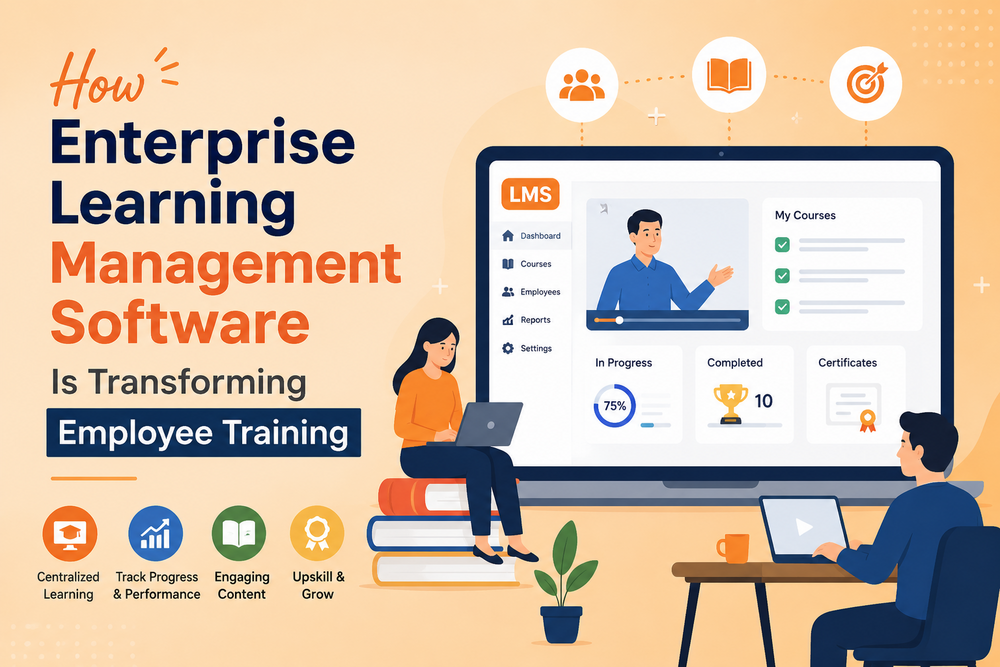
Rather than treating employee training as a collection of disconnected activities, an enterprise LMS brings learning, administration, tracking, and reporting into one centralized environment. It can help organizations deliver structured training while giving managers better visibility into employee progress and learning outcomes.
Why Employee Training Needs a More Connected Approach
Organizations often have different training requirements for different employees. A new employee may need onboarding, while an experienced sales professional may require product training. Compliance teams may need certification programs, and managers may need leadership development. Managing these programs through spreadsheets, emails, shared folders, and separate tools can create unnecessary administrative work.
An enterprise LMS provides a centralized approach where organizations can create courses, assign them to specific users or groups, monitor completion, and evaluate results from one platform.
This becomes particularly valuable for businesses managing distributed or large teams because learning programs can be delivered consistently across departments and locations.
1. Simplifying Employee Onboarding
Employee onboarding is one of the first opportunities organizations have to establish an effective learning culture. Instead of providing new employees with scattered documents and manually explaining every process, organizations can create structured onboarding programs through an LMS.
New employees can be assigned courses covering:
- Company policies
- Job responsibilities
- Product knowledge
- Workplace procedures
- Compliance requirements
- Tools and processes
- Role-specific training
Managers can then track whether employees have completed the required learning activities.
This creates a more consistent onboarding experience while reducing repetitive work for HR and training teams.
2. Delivering Role-Based Learning
Employees in different positions do not need identical training. An effective Enterprise Learning Management Software solution can support role-specific learning paths, allowing organizations to provide relevant courses based on an employee's department, responsibilities, skills, or career goals.
For example, a sales employee could receive product and sales training, while a technical employee could follow cybersecurity, technical skills, and compliance courses. Vidyalaya LMS supports role-based courses and personalized learning recommendations based on employee roles, skills, and performance.
This makes training more relevant while helping employees focus on the knowledge and skills they actually need.
3. Making Compliance Training Easier to Manage
Compliance training can become difficult when organizations need to manage certifications across large teams. An enterprise LMS can centralize compliance courses, track completion, monitor certifications, and send automated reminders when training needs to be completed or renewed.
This gives administrators greater visibility into compliance status without requiring them to manually check every employee record.
For industries where certifications and mandatory training are critical, this type of centralized tracking can significantly simplify training administration. Vidyalaya's enterprise LMS includes compliance training management, certification monitoring, reporting, and automated reminders.
4. Tracking Employee Progress With Real-Time Analytics
Creating training programs is only part of the process. Organizations also need to understand whether employees are completing courses and developing the intended skills.
Online Employee Training Software can provide dashboards and reports covering course participation, completion rates, assessments, certifications, and overall learning performance. These insights help managers identify employees who may need additional support and determine whether training programs are achieving their intended objectives. Vidyalaya's employee training solution includes real-time dashboards, performance reports, progress tracking, and analytics for identifying skill gaps.
Instead of relying on assumptions, training teams can use actual learning data to improve their programs.
5. Supporting Continuous Learning
Employee development should not end after onboarding. Technology, customer expectations, regulations, and business strategies continue to evolve, making continuous skill development important for organizations.
An LMS can provide employees with ongoing access to courses, assessments, certifications, and learning resources. Mobile accessibility can further allow employees to continue learning beyond traditional office environments. Vidyalaya LMS supports mobile learning and allows employees to access training through web and mobile devices, helping organizations build continuous learning programs.
6. Increasing Training Engagement
Training becomes less effective when employees simply complete courses to meet a requirement. Organizations need learning experiences that encourage participation and knowledge retention.
Features such as interactive assessments, blended learning, gamification, badges, rewards, and points can make employee training more engaging. Vidyalaya's employee training platform supports instructor-led and online training, assessments, collaborative learning, badges, rewards, and points to encourage learner engagement.
These elements can help turn training from a mandatory activity into a more continuous learning experience.
7. Preparing Organizations for AI-Powered Learning
AI is also changing how organizations approach employee development. AI-enabled learning platforms can analyze employee performance, identify potential skill gaps, and recommend learning paths based on individual requirements. Instead of assigning exactly the same training to every employee, organizations can move toward more personalized development.
This can be particularly useful when businesses are trying to build skills across large and diverse workforces.
The important point is that AI should support learning decisions rather than replace managers, trainers, or human judgment.
What Should Organizations Look for in Enterprise LMS Software?
Choosing the right platform requires more than comparing feature lists.
Organizations should consider whether the solution provides:
- Centralized course management
- Role-based learning paths
- Employee onboarding
- Compliance training
- Assessments and certifications
- Progress tracking
- Advanced analytics
- Mobile learning
- Integration with existing business systems
- Automated reminders
- Secure user management
- Scalability for growing teams
The platform should also be easy enough for administrators and employees to use without creating another layer of complexity.
Enterprise LMS and Employee Training: A Connected Future
The future of workforce learning is moving toward more personalized, measurable, and continuous development.
Enterprise Learning Management Software can provide the infrastructure organizations need to manage learning at scale, while Online Employee Training Software can support the day-to-day delivery of courses, assessments, certifications, and development programs.
When these capabilities are combined with analytics, automation, mobile accessibility, and AI-powered personalization, organizations can create a learning environment that grows alongside their workforce.
Conclusion
Employee training is becoming an ongoing business process rather than a series of isolated training sessions.
Enterprise Learning Management Software helps organizations bring courses, learners, assessments, compliance, certifications, analytics, and administration into one centralized platform. At the same time, Online Employee Training Software makes it easier to deliver personalized and accessible learning experiences across different teams and locations.
The real value of an LMS is not simply putting training online. It is creating a structured system where employees can continuously develop their skills, managers can measure progress, and organizations can connect learning with workforce development. For businesses looking to build a more capable and future-ready workforce, investing in a scalable LMS can turn employee training from an administrative responsibility into a strategic advantage.